
The Complete Guide For Michigan Homeowner's
A well-built brick patio or walkway does more than beautify your yard — it adds real, measurable value to your home, creates usable outdoor living space, and holds up against Michigan’s punishing freeze-thaw cycles for decades. But most homeowners come to us with the same question: where do I even start?
This guide covers everything: why brick pavers outperform other materials in Michigan, the most popular patio and walkway designs, what the installation process actually looks like, what you should budget, and how to choose the right contractor. If you’re serious about upgrading your outdoor space, read this first.
Michigan’s climate is one of the most challenging for outdoor hardscaping. Temperatures swing from below 0°F in January to 90°F in July, and the ground freezes and thaws repeatedly each season. Most materials crack, heave, or stain under this kind of stress. Brick pavers don’t — and here’s why they’re the preferred choice for serious Michigan homeowners.
Individual pavers flex with ground movement. When the soil shifts in winter, pavers shift with it and can be re-leveled in spring without jackhammers or full replacement.
A professionally installed brick paver patio or walkway, when properly sealed and maintained, routinely lasts 30–50 years. Poured concrete typically fails in 10–20 in Michigan conditions.
Studies consistently show a well-designed paver patio returns 50–80% of its cost in home resale value often more in competitive Michigan real estate markets.
Hundreds of brick colors, textures, and laying patterns mean your patio can look completely custom not like every other house on the block.
One of the biggest advantages of brick is the design range from classic colonial aesthetics to clean contemporary layouts. Here are the most popular options we install for Michigan homeowners.

Skip straight to a quote?
Grow Garden and Landscape Design serves homeowners across Southeast Michigan with professional brick paver patio and walkway installation. No pressure, no obligation.
Understanding the installation process helps you evaluate contractor quality and ask the right questions. Here’s how a professional brick paver patio should be built every time.
Before a single brick is touched, the area needs proper evaluation: drainage slope, soil composition, proximity to structures, and utility lines. A professional contractor stakes out the area and establishes precise grade to ensure water flows away from your foundation — not toward it.
The existing soil is excavated to a depth of 6–8 inches (deeper in areas with heavy clay soil, which is common in Southeast Michigan). This creates the critical void for your sub-base layers. Cutting corners here is the #1 cause of patio failure — don't let any contractor skip this step.
A compacted layer of crushed limestone or gravel — typically 4–6 inches — forms the structural foundation. This layer provides drainage, prevents frost heaving, and gives the system the load-bearing capacity it needs. It's compacted in lifts using a plate compactor, not just dumped and leveled.
A 1-inch layer of coarse sand is screeded smooth across the compacted gravel. This layer allows for fine-tuning of the level and gives the bricks something to "set" into without mortar.
Plastic or aluminum edge restraints are staked around the perimeter before bricks are laid. These are non-negotiable — without them, the edges of your patio will spread and migrate over time, causing gaps and an uneven surface.
Bricks are laid in the chosen pattern, starting from a fixed straight edge. A rubber mallet sets each brick firmly into the sand. Spacers or consistent technique maintains the 1/8-inch joint spacing throughout. Cuts are made with a wet saw for clean, precise edges.
Polymeric sand — a mixture of fine sand and binding agents — is swept into all joints and activated with water. When it cures, it hardens to resist ant infiltration, erosion, and weed growth. This is a significant upgrade over plain sand joints and should be standard on any quality installation.
A penetrating or film-forming sealer protects your bricks from oil stains, UV fading, and moisture intrusion. It also enhances color and gives your patio a finished, polished appearance. We recommend resealing every 3–5 years depending on traffic and weather exposure.
A brick walkway serves a practical purpose, connecting your driveway to your front door, winding through a garden, or linking patio areas but it’s also one of the first things guests and potential buyers notice. A well-designed walkway elevates your entire home’s curb appeal instantly.
Front entry walkway: 4–5 feet minimum (allows two people to walk side by side comfortably)
Garden path: 2–3 feet (intimate, informal feel)
Service/side yard path: 3–4 feet (functional clearance)
Unlike patios, walkways need to account for directional traffic, so patterns that reinforce a visual “flow” work best running bond and herringbone at 45° both accomplish this. Curves add character but require more precise cutting and planning. Straight walkways are more cost-effective and visually strong for formal home styles.
In Michigan, walkway drainage is especially important. A slight cross-slope (typically 2% grade) ensures water doesn’t pool on the surface and freeze into a slip hazard in winter.
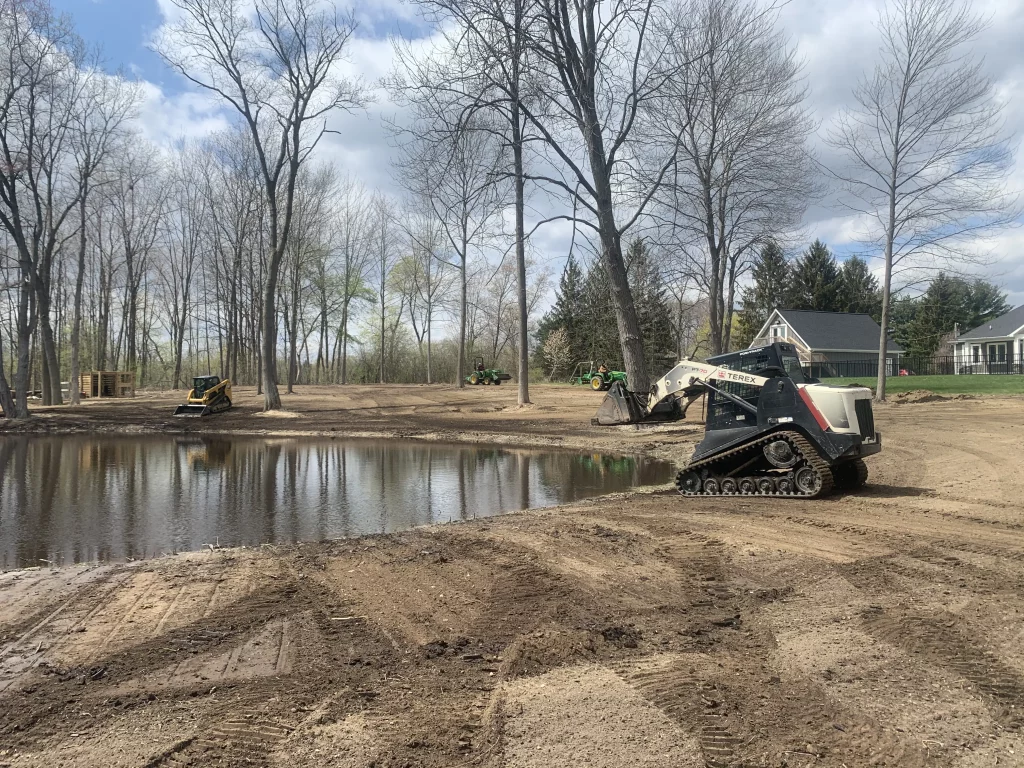
Grow Garden and Landscape Design isn’t a general contractor that occasionally lays brick. hardscaping is a core specialty. Our team has installed hundreds of brick paver patios and walkways across Southeast Michigan, from Ferndale to Grosse Pointe to Royal Oak. We bring the same attention to sub-base engineering, pattern precision, and finishing quality to every project, regardless of size.
Beyond brick patios and walkways, we offer a full suite of hardscaping and landscaping services retaining walls, natural stone installation, fire pit installation, SOD installation, and full landscape design, so, we can handle your entire outdoor transformation under one roof.
Ready to build something that lasts?
Contact Grow Garden and Landscape Design for a free, no-obligation estimate on your Michigan brick patio or walkway project. We’ll walk your property, discuss your vision, and put together a detailed proposal typically within 48 hours.
Most residential brick patio installations in Michigan take 2–5 days depending on size and complexity. Walkway-only projects often complete in 1–2 days. Larger projects with steps, walls, or drainage work may take 1–2 weeks.
Late spring through early fall (May–October) is ideal. Bricks can be installed in cooler weather, but polymeric sand needs temperatures above 32°F to cure properly. Many contractors offer off-season pricing in March–April and October–November.
Quality concrete or clay pavers rated for freeze-thaw exposure (ASTM C936 or C902 standards) do not crack in normal Michigan winter conditions. The key is proper installation specifically a deep enough gravel sub-base that prevents frost from penetrating and creating uplift pressure.
The most common paver size is 4″ × 8″ (standard modular brick). Many contractors also use 4″ × 4″, 6″ × 6″, or larger format pavers depending on the design. Thickness is typically 2⅜” for pedestrian applications.
Absolutely and it’s one of the most popular upgrades Michigan homeowners request. A fire pit surrounded by a circular or square brick seat wall integrates seamlessly with a paver patio and dramatically extends how long you can enjoy the outdoor space each season. Grow Earth installs custom fire pit features as part of complete patio projects.
Requirements vary by municipality. Most cities and townships in Southeast Michigan do not require permits for ground-level patios under a certain square footage threshold but it’s always worth checking with your local building department, especially if your project includes a structure, electrical, or gas feature.
If your patio was installed with polymeric sand, weed growth should be minimal. For existing patios with regular sand joints, remove weeds manually, then re-sweep with polymeric sand to fill gaps. A joint sealer applied over the top adds a second line of defense.
Got a vision? Let’s bring it to life together!